
Free Carfax Check Before You Buy: What You Can See Before Paying
Start with a free VIN check, see if a report exists, then buy a very low-cost vehicle history report only when the car is worth checking.
A used car can look clean in photos, sound convincing in the listing, and still hide a history that changes everything. Before you pay for a full vehicle history report, start with the simplest question: does a report exist for this VIN at all? CFax lets you begin with a free VIN check, confirm that records are available, and then buy a very low-cost full report only when the car is worth a closer look.
This guide explains what a free Carfax check can honestly mean, what you should expect before payment, what a full report can reveal, and how to use a low-cost report before you send a deposit, travel to see a car, or negotiate with a seller.
CFax is an independent vehicle history report service and is not affiliated with Carfax. We use phrases such as "Carfax check" and "Carfax report" because that is how many used-car buyers search for VIN-based history reports online.
What buyers really mean by "check Carfax free"
When people search for check Carfax free, they are usually trying to avoid a blind purchase. They do not want to pay first and only then discover that no useful records are available. A fair free check should help you answer the first layer of questions before you spend money:
- Is a vehicle history report available for this VIN?
- Does the VIN decode to the expected make, model, year, body type, fuel type, and engine?
- Does the basic vehicle information match the seller's listing?
- Is the car interesting enough to order the full report?
- Are there early signals that you should slow down before paying a deposit?
That is the practical value of the free step. It is not a promise that the entire paid report is free. It is a way to check whether buying the full report makes sense.
Free VIN check first, full report second
The safest workflow is simple: enter the VIN, confirm that a report was found, review the basic vehicle details, and only then decide whether to buy the full report. This matters because used-car decisions often happen under pressure. A seller may say there are other buyers, the price may look attractive, or the car may be far away. The free VIN check gives you a pause before you spend more time or money.
If the report is found and the basic vehicle facts match the car, the next step is the full history. If the VIN points to a different year, trim, body type, or engine than the listing claims, that is already a reason to ask questions before paying for anything else.
Why a cheap Carfax-style report can still be trustworthy
A cheap Carfax report should not feel like a trick. The word "cheap" is useful for search because buyers compare prices, but the better promise is "very low-cost and transparent". A trustworthy low-cost flow should be clear at every step:
- you enter the VIN first;
- you see whether a report exists;
- you review basic vehicle information before payment;
- you know the price before buying;
- payment is processed securely;
- the full report is delivered as a PDF by email.
That is why the best call to action is not "buy now" at the beginning. The better first step is: start with a free VIN check. If the report exists and the vehicle looks relevant, then buying the full report becomes a rational next step.
When should you buy the full vehicle history report?
You do not need a full report for every random car you scroll past. Buy it when the car is a serious candidate. A full report is especially useful when:
- the price looks unusually low for the market;
- the seller avoids detailed questions about history;
- the car was imported from the USA or Canada;
- you are considering sending a deposit before seeing the car;
- you plan to travel to inspect the vehicle;
- the listing mentions accident repair, auction sale, insurance history, or rebuilt status;
- you want negotiation evidence before making an offer.
A report does not replace a mechanic's inspection. It gives you the paper trail so you know where the inspection should focus.
Example: what a full report can reveal at a glance
The overview page is often enough to tell you whether the car needs deeper investigation. In the redacted example below, the report immediately shows a salvage title, accident and damage information, previous owners, service history records, and detailed records available.
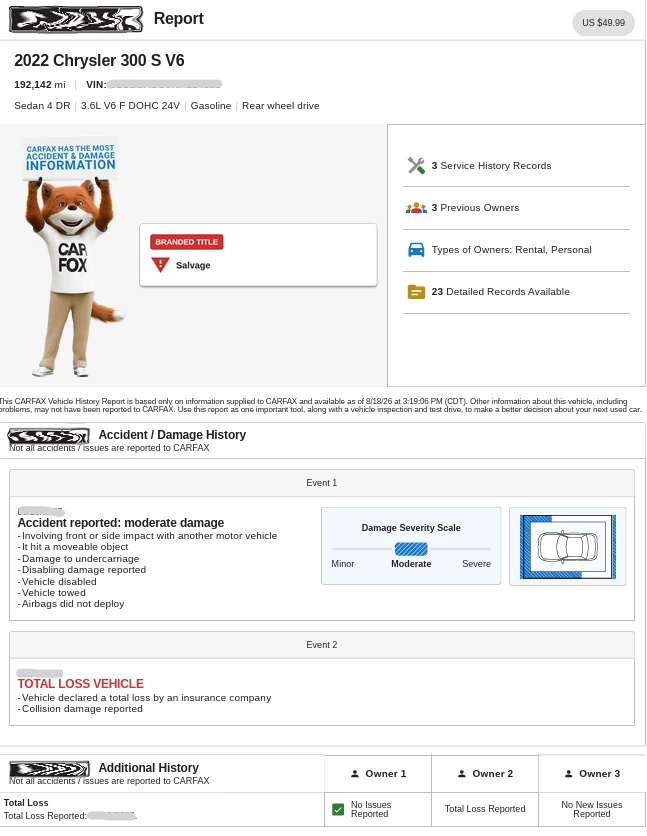
Do not read the summary as a final verdict. Read it as a map. It tells you which sections deserve attention: accident history, title history, ownership history, odometer records, service records, and later events such as export or insurance transfer.
Title history: salvage, rebuilt, flood, lemon, and other brands
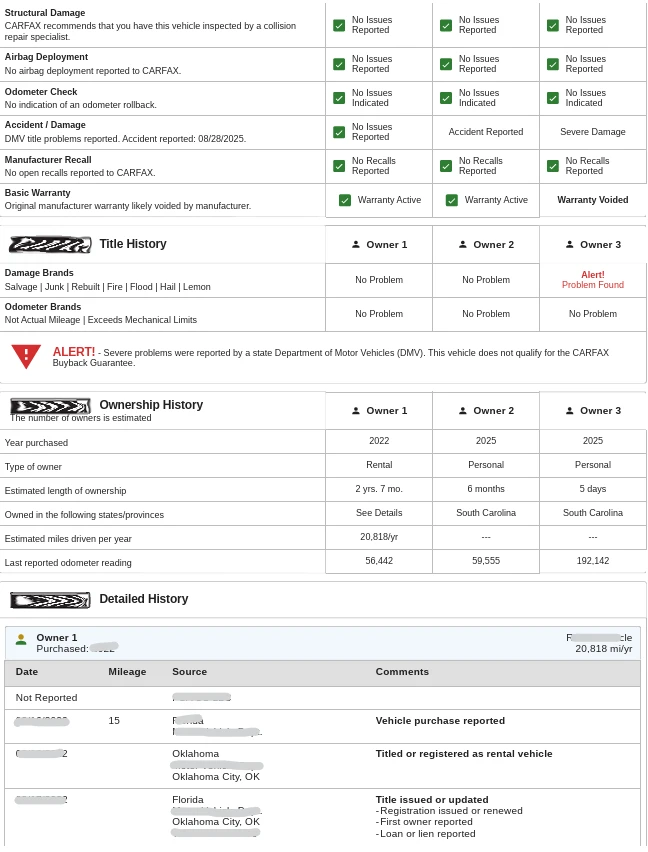
Title history is one of the most important parts of a vehicle history report. A branded title can change the car's value, financing options, insurance options, and resale potential. Common title-related words to watch for include salvage, rebuilt, flood, fire, hail, lemon, junk, or insurance loss.
A salvage title usually means the vehicle was declared a total loss by an insurance company or another authority. That does not automatically mean the car is impossible to buy, but it does mean you need to be careful. You should verify the quality of repairs, inspect the structure, check airbags and safety systems, and understand that resale value may be much lower.
Ownership history: how the car was used matters
Ownership count is not just a number. A car with three owners in a short period may deserve more questions than a long-term one-owner vehicle. The type of owner also matters. Rental, personal, lease, commercial, or fleet use can tell you how the vehicle may have been driven and maintained.
For example, a former rental car is not automatically bad, but it may have seen many drivers and harder use. A personal vehicle with consistent service records may be easier to evaluate. A car that changes owners shortly after a damage event can also be a signal to inspect carefully.
Odometer history: look for a logical mileage story
Odometer fraud is one of the classic used-car risks. A report helps because mileage can be recorded at registration, service visits, inspections, title events, auctions, and ownership changes. The numbers should move forward in a believable pattern.
Be cautious if mileage drops, stays flat for a long time while the car is supposedly used, jumps in a way that does not fit the timeline, or does not match the physical wear of the vehicle. A shiny steering wheel, worn pedals, sagging seats, and a "low mileage" claim should be checked against the report.
Accident and damage history: read the details
An accident record is not always the same level of risk. A minor parking scrape and a structural collision are very different. Look for the damage location, damage severity, whether airbags deployed, whether the vehicle was towed, whether the car was disabled, and whether later service records support a proper repair story.
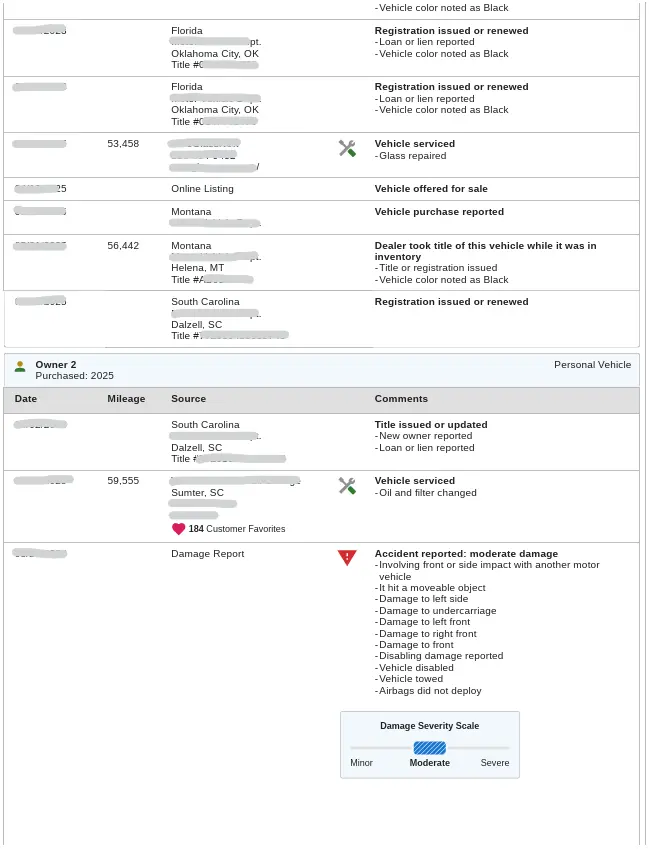
Use the report to guide a physical inspection. If the report mentions front impact, undercarriage damage, towing, or airbags, ask the mechanic to inspect those areas specifically. If the seller says "just a small scratch" but the report says moderate damage, that gap matters.
Total loss, insurance records, and salvage title
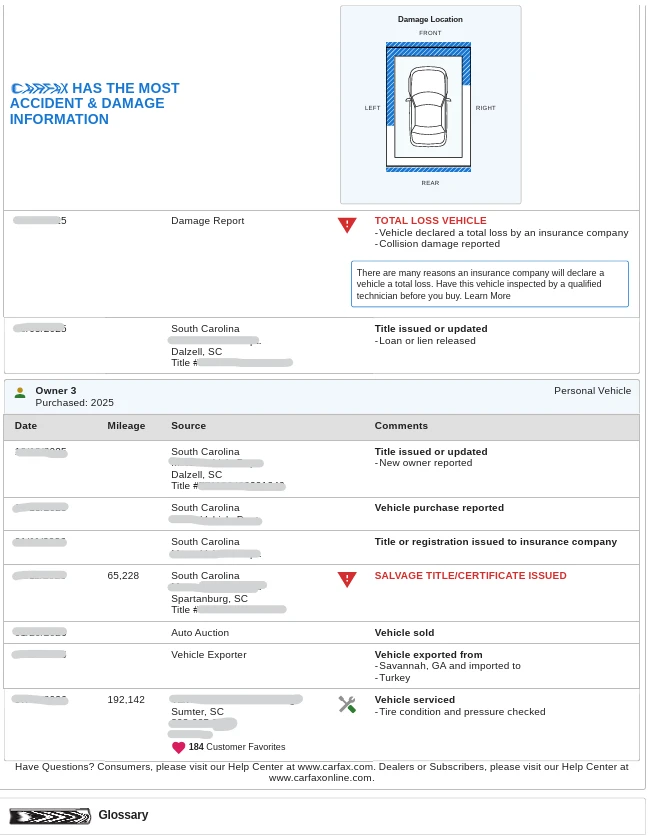
Total loss is one of the strongest warning signals in a vehicle history report. It generally means an insurance company or authority considered the damage serious enough that repair was not economically justified at the time. A total loss event may later connect to salvage title, auction sale, rebuilt status, export, or a major price discount.
This does not mean every total-loss car is worthless. Some buyers knowingly purchase repaired salvage vehicles. But you should never buy one accidentally. If the report shows total loss or salvage, the price, inspection depth, and risk tolerance must all change.
Export records: why they matter for imported cars
Many cars from the USA and Canada are exported after auction, damage, insurance events, or dealer resale. An export record can help explain how the car moved from one market to another. For buyers outside North America, this is especially useful: the local listing may show only the current condition, while the report can reveal the earlier story.
Service history: useful, but not always complete
Service records can show oil changes, tire service, glass repair, inspections, dealer visits, and other maintenance events. They are helpful because they make the timeline more believable. But missing service records do not automatically mean the car was neglected. Not every repair shop reports data, and some owners keep paper records privately.
Use service history as supporting evidence. A car with regular service records, consistent mileage, and no major title issues is easier to trust. A car with severe damage and almost no maintenance history deserves a much tougher inspection.
How to use the report before talking to the seller
A report is most powerful when you use it before negotiation. Instead of asking vague questions, ask precise ones:
- "The report shows a damage event. Which panels were repaired?"
- "Was the car inspected after the accident?"
- "Do you have repair invoices or photos before repair?"
- "Why does the title history show salvage or insurance involvement?"
- "Can my mechanic inspect the undercarriage and front structure?"
- "Does the current mileage match the latest record?"
A good seller should be able to answer calmly and provide supporting documents. If the seller becomes defensive, refuses inspection, or pressures you to pay immediately, treat that as another red flag.
Free check vs full report: what is the difference?
The free VIN check is the filter. It helps you decide whether a full report exists and whether the vehicle is worth more attention. The full report is the decision tool. It gives you the deeper history that can affect price, safety, negotiation, and whether you should walk away.
| Step | What it helps you decide | Best moment to use it |
|---|---|---|
| Free VIN check | Whether a report exists and basic vehicle data matches | Before paying or contacting the seller seriously |
| Full vehicle history report | Whether the car has accident, title, ownership, mileage, service, or export risks | Before deposit, inspection trip, negotiation, or purchase |
Frequently asked questions
Can I check Carfax for free?
You can run a free VIN check on CFax to see whether a vehicle history report is available before paying. The full report is paid, but the free step helps you avoid paying blindly.
Is a cheap Carfax report the same as a free report?
No. The free step confirms whether a report exists and whether the vehicle details look relevant. The cheap or low-cost step is the full paid vehicle history report you order after that.
What can I see before buying the full report?
You can confirm that a report was found and review basic vehicle information when available. That may include make, model, year, body type, fuel type, engine details, manufacturer, and plant country.
Should I buy the report before seeing the car?
If the car is far away, expensive, imported, suspiciously cheap, or requires a deposit, buying the report before visiting can save time and money. For a local car you are only casually browsing, start with the free check first.
Does a clean report guarantee the car is safe?
No report can guarantee condition. A vehicle history report is a powerful screening tool, but it should be combined with a physical inspection, test drive, seller documents, and mechanic review.
What should be blurred in report screenshots?
Blur the full VIN, owner names, addresses, purchase dates, registration locations, document numbers, phone numbers, emails, and any other identifying information. Keep the educational parts visible: title brands, accident type, damage severity, ownership count, service category, and export or salvage signals.
Start with a free VIN check. If a report is found, buy the full vehicle history report before you decide on the car.