
What Does a Salvage Title Mean?
A salvage title means an insurer declared the car a total loss — not that it is scrap. What the brand means, how salvage differs from rebuilt, what it does to value and insurance, and how to check it by VIN.
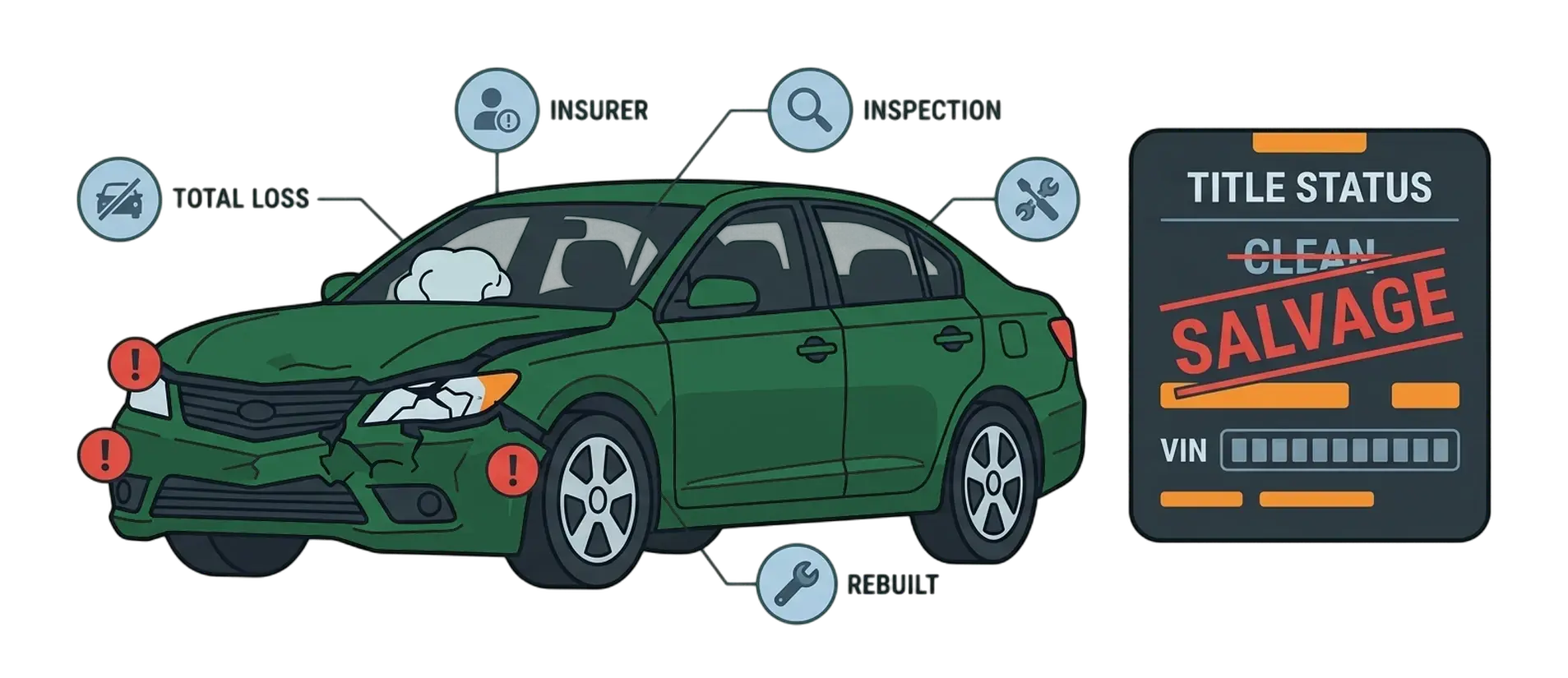
A salvage title is a permanent mark on a car's US ownership document meaning an insurance company declared the vehicle a total loss. It is one of the most misunderstood words in the used-car market: it does not mean scrap metal, and it does not mean the car is unsafe. It means something significant happened and was written down. Here is what the brand actually means, what it changes for a buyer, and how to see it by VIN before you pay.
What a salvage title means
In the United States, ownership of a car is recorded on a document called a title, issued by the state. When an insurer pays out a claim and decides the car is not worth repairing, it takes ownership of the wreck and the state cancels the clean title, replacing it with a salvage title. From that moment the car carries a brand — a label describing its condition that follows the vehicle identification number, not the piece of paper.
That last part is the one people miss. Brands are attached to the VIN and stay in the record permanently. Selling the car, repairing it, or exporting it to another country does not erase the entry. The car's local paperwork can be brand new and perfectly clean while the American record still shows exactly what happened.
When a car gets branded
An insurer declares a total loss when repairing the car costs more than it is worth keeping. The exact trigger is set by state law and differs across the country: some states use a fixed percentage of the car's pre-accident value, with thresholds ranging from around 50% to 100% depending on the state, while others apply a total loss formula that compares repair cost plus salvage value against the car's actual cash value.
Two consequences follow from this. First, the same damage on the same car can be a total loss in one state and a repairable claim in another. Second — and this is the part that surprises buyers — an expensive car needs proportionally less damage to cross the line. A luxury sedan with a deployed airbag, a bent bumper beam and a few sensors can exceed the threshold while looking almost intact.
Collisions are not the only cause. Cars are also branded after flood and storm damage, hail, fire, vandalism, and in some cases after being recovered following a theft when the insurer has already paid the claim.
Salvage, rebuilt and clean: the difference
These three words describe three different stages, and mixing them up is expensive.
Clean title means no brand has ever been added. It is not a guarantee that nothing ever happened to the car — only that no insurer wrote it off. Damage repaired out of pocket, without a claim, leaves no title brand at all.
Salvage title means the car has been written off and not yet repaired to a road-legal standard. In most states a salvage-titled vehicle cannot be registered or legally driven on public roads in that condition; it can be bought, sold and transported, which is why these cars fill auction lots.
Rebuilt title (also called reconstructed or rebuilt salvage depending on the state) is what a salvage car becomes after it has been repaired and passed a state inspection that returns it to the road legally. The brand does not disappear — it changes to reflect that the repair happened and was checked.
What it changes for the buyer
Value. A branded car sells for meaningfully less than an identical clean-title one. Published estimates commonly put the gap somewhere in the range of 20–40%, though the real discount depends on the damage, the quality of the repair and the local market. If a branded car is priced like a clean one, the brand is not the problem — the price is.
Insurance. Coverage on rebuilt-title cars is available but usually narrower. Insurers routinely write liability cover and are far more reluctant to offer comprehensive or collision on a vehicle whose pre-damage condition they cannot verify. Policies vary by insurer and by country, so check before you buy rather than after.
Financing and resale. Lenders are more cautious about branded collateral, and your future buyer will run the same check you are running now. Whatever the record shows today, it will still show it in five years.
Safety. This depends entirely on the repair, not on the word. A car rebuilt properly with structural work done to specification can be perfectly sound; one straightened badly in a shed is not, and the title looks identical in both cases. A pre-purchase inspection by an independent mechanic is not optional on a branded car.
Why this matters far outside the USA
Written-off American cars do not stay in America. A large share of them is bought at auction and exported, and Eastern Europe is one of the main destinations — in some markets, cars with this brand have historically made up the majority of used American imports. Our review of the statistics on US car imports goes through the numbers and their limits in detail.
The practical problem for a European buyer is that the American record does not travel with the car. The receiving country issues its own registration document describing the vehicle as it is at that moment. A clean local document proves the car was registered locally. It does not prove the history is clean — those are two different statements, and usually only one of them is being made.
Title washing: how brands get hidden
Because titles are issued state by state, a branded car can be moved and re-titled somewhere the brand is not carried over correctly. That practice is called title washing, and it is exactly what the National Motor Vehicle Title Information System (NMVTIS) exists to stop. NMVTIS is a federal database, overseen by the US Department of Justice, into which states, insurers, salvage yards and auto recyclers report title and total-loss data, and it keeps the history of every brand any state has applied to a VIN.
One caveat is worth stating honestly: reporting is not uniformly complete, so "nothing found" is weaker evidence than "something found". A record that shows a brand is close to conclusive. A record that shows nothing means no brand has been reported — not that nothing ever happened.
How to check a car for a salvage title
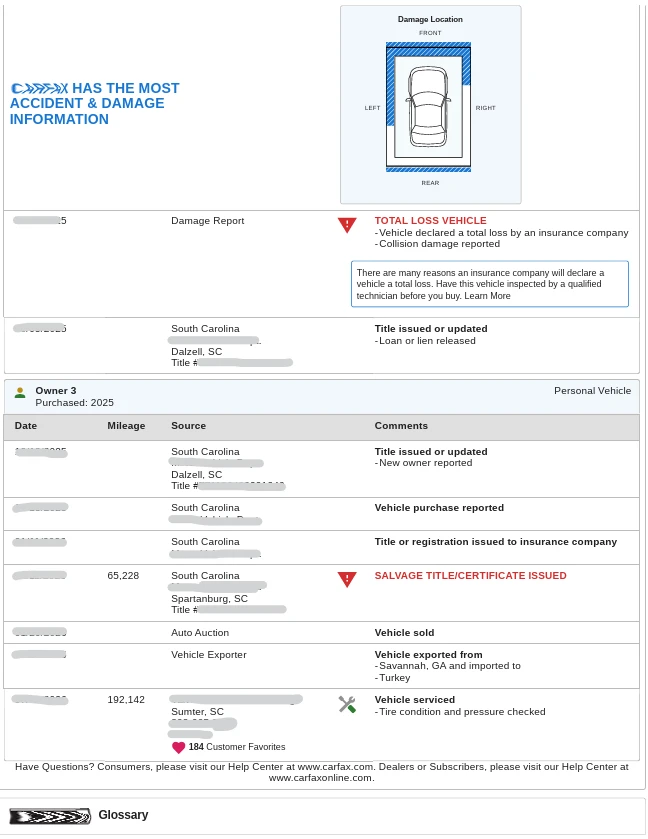
All of this is checkable before you pay, and it starts with 17 characters. Enter the VIN on the CFax homepage for free and you will immediately see how many records exist for that car plus its basic specs — no registration required. If the car is worth pursuing, buy the full vehicle history report for a few dollars and read the title and damage sections: brands, total-loss records, accident and mileage entries. Download it as a PDF and bring it to your mechanic or put it in front of the seller. More answers are in our FAQ.
Frequently asked questions
Can you drive a car with a salvage title?
Not in that state, in most cases. A salvage title means the car has been written off and not yet certified as road-legal again, so it generally cannot be registered, insured for normal road use, or legally driven on public roads while the brand stands. To put it back on the road, the vehicle has to be repaired and pass a state inspection, after which it is re-titled as rebuilt. Rules for that inspection differ from state to state, and cars exported abroad are registered under the receiving country's own rules instead.
Is a rebuilt title car worth buying?
It can be, provided two conditions hold: you know about the brand before agreeing on a price, and the price reflects it. A properly rebuilt car with documented, professional structural repair can serve for years, and the discount against a clean-title equivalent is real money. The risks are equally real — hidden shortcuts in the repair, narrower insurance options, and a lower resale price when your turn comes to sell. Treat an independent pre-purchase inspection as mandatory, not as a nice-to-have.
Does a salvage title ever go away?
No. The brand is attached to the VIN and stays in the vehicle's history permanently. Repairing the car changes the brand to rebuilt rather than removing it, and selling or exporting the vehicle does not clear the record either. Attempts to make a brand disappear by re-titling a car in another state are what title washing means, and the national database exists precisely to catch them. Anyone checking the VIN later — including the person who buys the car from you — will see the same entry you see today.
Will a vehicle history report show a salvage title?
Yes, title brands are one of the core things any VIN-based report is built to surface, alongside accident records, mileage readings and ownership history. A Carfax report is the best-known example, and CFax gets you that report by VIN for cars from the USA and Canada. You can check any VIN on our homepage for free to see whether records exist at all, then buy the full report only if the car is worth the money. One caution applies to every provider: an empty result means nothing was reported, not that nothing happened.
Keep reading: 7 red flags when buying a used car · how to read a vehicle history report
Looking at a car with an American history? Run a free VIN check and see whether a title brand is on record.