
Odometer Rollback: How to Detect It by VIN
Compare dated mileage records with the dashboard, check units and title warnings, and learn what a VIN history report can—and cannot—tell you.
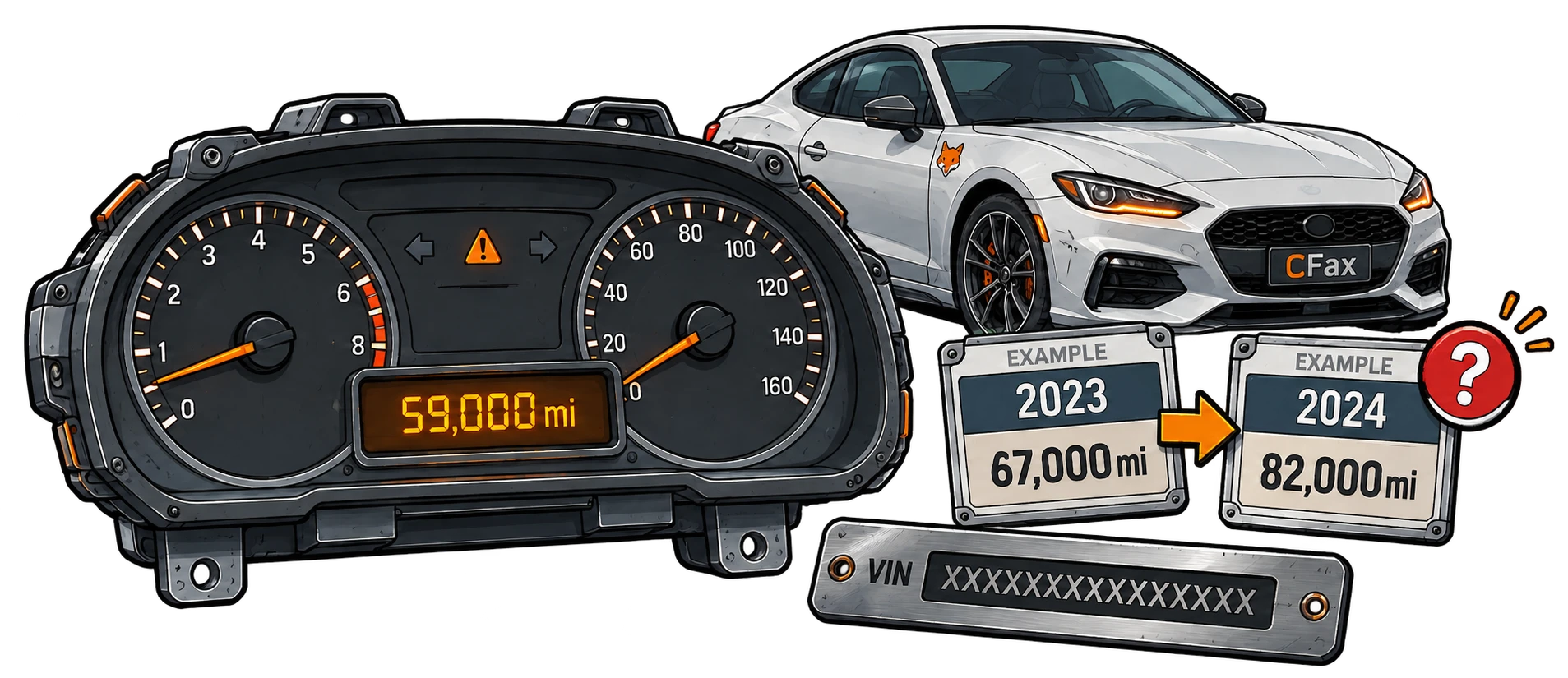
To check for odometer rollback by VIN, compare dated mileage records with the car's current dashboard reading. A later reading below an earlier one is a warning to investigate. It is not, by itself, proof that the seller committed fraud.
The useful question is not simply “Does this car look low-mileage?” It is “Can the seller explain the mileage history of this particular vehicle?” Here is a practical way to answer it before paying a deposit.
What a VIN check can tell you about mileage
A VIN decoder identifies vehicle information encoded in the identification number. It does not establish how far the car has travelled. Mileage checks need dated records associated with that VIN, rather than a calculation from the VIN itself. NHTSA VIN decoder
Depending on what has been reported, a history report may contain odometer readings and service or registration events. Coverage varies: not every event reaches the report. Our guide to reading a vehicle history report explains which sections to review before buying.
Do not assume all VIN reports contain the same information. The US National Motor Vehicle Title Information System, or NMVTIS, is focused on title, brand and related history, including the most recent reported odometer reading. That is different from a complete maintenance timeline. BJA consumer guide
How to check for odometer rollback by VIN
1. Confirm which vehicle you are checking
Compare the VIN on the vehicle with the VIN on its documents and the report. Keep a copy of the listing and a dated photo of the dashboard, including the distance unit. If you are buying remotely, request those photos before discussing a deposit.
For the basics, read what a VIN is and where to find it.
2. Make a dated mileage timeline
Put each available reading in date order. Record its source and unit as well as the number. Keep the original entries beside any converted values; do not silently replace them.
The table below is an invented teaching example, not an actual vehicle report:
| Date | Source | Recorded reading | Question to ask |
|---|---|---|---|
| 2022-06-10 | Service invoice | 48,000 miles | Does the invoice show the same VIN? |
| 2023-08-18 | Inspection record | 67,000 miles | Can the original record be obtained? |
| 2024-11-03 | Service invoice | 82,000 miles | Does the workshop confirm the entry? |
| 2026-10-08 | Dashboard photo | 59,000 miles | Why is today's reading below the earlier one? |
The last reading is 23,000 miles below the previous recorded figure. That discrepancy needs an explanation supported by documents. It does not establish the car's exact current mileage or identify who caused the discrepancy.
3. Investigate drops, rather than guessing
A lower later reading can indicate rollback. The report provider's guidance also warns that odometer accuracy is not guaranteed and recommends verification with a dealer or qualified mechanic. Mileage accuracy guidance
For every unexplained drop, ask:
- Is this the same VIN throughout?
- Are the dates and units being compared correctly?
- Is the source entry accurate? Request the original invoice or inspection record.
- Was the instrument cluster or odometer replaced? Ask for the repair documentation and readings before and after replacement.
A typo or replacement is a possibility to investigate, not an explanation to accept on the seller's word. If the record appears wrong, ask the seller to help resolve it with its source and the report provider. The provider has a documented correction process; a buyer checking someone else's car may need the owner to initiate it. Correction guidance
4. Read mileage warnings separately from the numbers
Look for an explicit mileage warning in the title or report, not just a smooth sequence of readings. California DMV, for example, distinguishes Not Actual Mileage from Exceeds Mechanical Limits: the former can reflect a broken or replaced odometer or uncertainty about the true distance; the latter refers to a mechanical odometer rolling past its display limit. Neither term should be treated as a promise of verified low mileage. Wording and handling should be checked with the issuing authority. California DMV definitions
Buying an imported car? Check miles versus kilometres
A change of market can make a timeline confusing. Compare the distance units shown on the original documents, the history report and the current dashboard.
For example, 60,000 miles is approximately 96,561 kilometres. These figures can represent the same distance; they are not automatically evidence of a mileage jump. Conversely, a seller should not describe 60,000 miles as 60,000 kilometres.
When a report has already converted units, do not convert it a second time. If the unit is unclear, leave that entry unresolved until its source confirms it. Ask for records from both before and after import; a US history alone does not establish what happened during later ownership abroad.
What if the report has no mileage readings?
An empty mileage section leaves the question unanswered. It is neither proof of rollback nor confirmation of honest mileage.
The same caution applies to a long gap or repeated readings: these are questions for the seller, not a diagnosis. Request missing documents and establish whether the vehicle was being driven, stored or recorded without an updated reading. If the available history cannot explain the claimed mileage, treat it as unverified when deciding whether to proceed.
No report has every vehicle's complete history. A sequence without a warning therefore cannot certify the dashboard reading.
Check the car as well as its paperwork
NHTSA recommends comparing the odometer with title, maintenance and inspection records, and looking at wear such as pedals. Digital odometers can also be altered; a tidy display does not establish accuracy. NHTSA odometer-fraud guidance
Physical wear is supporting evidence, not a mileage counter. Ask an independent mechanic to examine the car and review the discrepancy you found. The FTC advises that a history report does not replace an independent inspection. FTC used-car guidance
What to do when the mileage does not add up
Pause the purchase and make the question specific: “This record shows 82,000 miles, but today's dashboard shows 59,000. Can you provide the original record and any odometer-replacement paperwork?”
Keep the listing, messages, report and photos. If the seller cannot substantiate an explanation, you can decline the purchase without proving fraud. Do not let a deadline replace evidence.
If you suspect fraud involving a US vehicle, NHTSA directs individual complaints to the relevant state enforcement agency. For a purchase abroad, identify the appropriate local authority rather than assuming US procedures apply. NHTSA reporting guidance
Frequently asked questions
Can I check the true mileage using only the VIN?
The VIN lets you look for associated records. It does not encode the car's accumulated mileage. You need a timeline, supporting documents and an inspection; an exact true mileage may remain unknown.
Does a mileage drop always mean odometer rollback?
No. Check the original entry, units and any replacement paperwork. An unexplained drop is a reason to stop and investigate, not a finding about who committed fraud.
Can a digital odometer be rolled back?
Yes. A digital display does not prevent tampering. Compare its reading with dated documents instead of relying on how the dashboard looks. NHTSA guidance
Does a free VIN check include the full mileage history?
CFax's free step checks report availability; the full report is paid. Finding a report does not guarantee that it contains enough mileage records to resolve your question. See what you can check before paying.
Check the VIN before you commit
Start with a free VIN check on CFax. If a report is available, decide whether to buy the full report and review its recorded history alongside the seller's documents. Neither the free check nor a paid report certifies the car's true mileage or replaces an inspection.
Read next: how to read a vehicle history report and other warning signs when buying a used car.